Spiders Keep Appearing Indoors
Indoor spiders tell you a room is feeding them: they live where other insects live. A residual barrier spray on entry points, plus removing their food and shelter, ends most houses' spider traffic. Killing spiders one by one does not.
The short answer
Treat the routes, not the spiders: spray Ortho Home Defense along baseboards, window frames, door thresholds, and the foundation line, and clear the clutter and insect food that sustain them. It holds 4.4 stars from 15,428 ratings at Walmart (November 2026). This page repeats only the product's label claims; the 'months of protection' language on some packaging is disputed, and we do not rely on it.
Why does this happen?
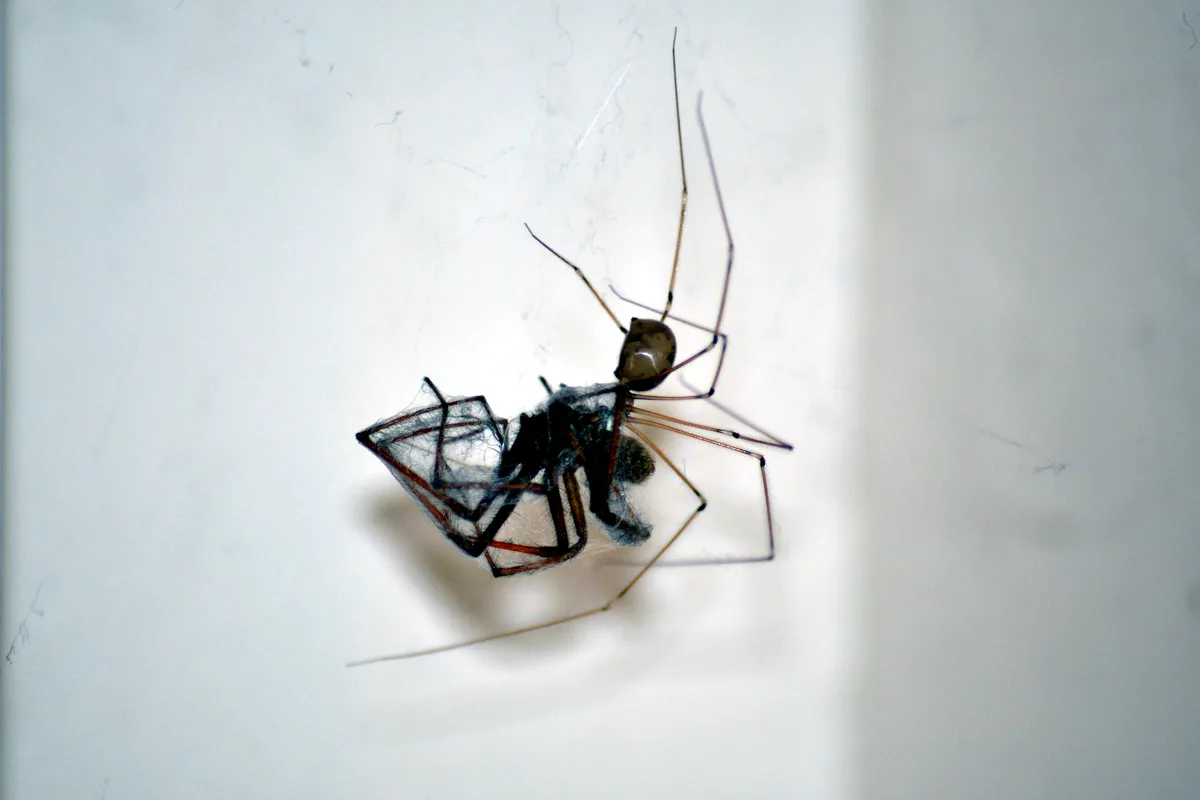
Most indoor spiders are wandering hunters or web builders exploiting two resources: harborage (undisturbed corners, clutter, stored boxes against walls) and prey (the gnats, flies, ants, and other insects a house supplies). A spider in the open is usually a male wandering in mating season, which is why sightings spike in autumn. Killing visible spiders touches neither resource, and a house with abundant prey re-stocks its spiders continuously from outdoors and from wall voids.
A barrier spray works on the traffic rather than the residents: crawling insects crossing treated baseboards and thresholds pick up the insecticide and die, which both removes spider prey moving through and intercepts spiders themselves. Its effect is measured in weeks of residual action under indoor conditions, whatever the boldest packaging language says, and it pairs with the unglamorous work: decluttering harborage, vacuuming webs and egg sacs, sealing gaps, and fixing the insect problems (drains, pantry, lights drawing prey to windows) that stock the spiders' pantry.
The fix, in order
Cheapest first, in order. When a step solves it, you are done; the product step is for the cases the free steps cannot finish.
Free step
Vacuum the residents and their real estate
Webs, egg sacs, and corner clutter first: a thorough vacuum of baseboards, closets, and the basement rim removes spiders, their eggs, and the harborage map in one pass. Empty the vacuum outdoors.
Free step
Cut the food supply
Fix the prey sources named elsewhere in this family: drain flies, pantry moths, ants. Outdoor lights left on all night draw in the insects spiders eat. A timer, or switching to motion-only lights, cuts off that food supply.
The product step
Lay the barrier where traffic runs
Spray Ortho Home Defense in a band along baseboards, around window and door frames, at pipe penetrations, and around the foundation outside, per the label's indoor and outdoor directions, keeping it off food surfaces and away from children and pets until dry, exactly as the label requires.
The product for this step
Ortho Home Defense insect barrier spray
Habit step
Seal and declutter the perimeter
Caulk gaps at frames and siding, move stored boxes off basement floors and away from walls, and keep firewood and vegetation off the foundation. The barrier handles crossers; the environment decides how many try.
The evidence, in tiers
Tier 1 · The method
Barrier treatment of travel routes plus prey and harborage reduction is integrated pest management as extension services publish it; label-claims-only language is this site's rule for every registered pesticide.
Tier 2 · This product
Ortho Home Defense holds 4.4 stars from 15,428 ratings at Walmart (November 2026). We repeat no duration claim for the barrier: the label's own terms govern, and owner experience under indoor conditions runs in weeks.
We have not sprayed a test house for this guide. The method is extension-standard IPM, and pesticide statements here do not exceed the product label.
Tier 3 · What owners report
Owners report the pattern IPM predicts: sightings fall sharply in the first weeks, returns gather at untreated zones and cluttered storage, and autumn wanderers still appear singly, which is new spiders arriving, not a failure of the work.
The alternatives, conceded where they win
| Option | What it is | The honest verdict |
|---|---|---|
| Ortho Home Defense barrier plus IPM | Residual band on travel routes, with food and shelter removed | The pick for a house-level pattern: it treats traffic and territory, the two scales at which spiders operate. |
| Spider-specific sprays and traps | Contact sprays and glue boards marketed for spiders | Wins on a single spider in a single room; glue boards do monitor activity honestly. It loses as a strategy, touching neither prey nor entry, so the house restocks on schedule. |
| Ultrasonic pest repellers | Plug-in sound devices | Loses on evidence: controlled studies and regulator actions have repeatedly found no reliable effect on spiders or insects generally. Plug-in devices sold as spider repellents do not work, and this page does not recommend them. |
The honest price comparison
The honest comparison is the quarterly pest contract at $300 to $500 a year, whose core act for spiders is this barrier plus a vacuum. A gallon at $13 to $17 covers a house's perimeter several times over; the labor is yours, and it is an afternoon.
Where it falls short
What follows is drawn from the product's own reviews: the complaints and failures buyers report after living with it.
- It is a pesticide: the label's precautions (dry before contact, off food surfaces, away from aquariums and pet areas until dry) are part of the method, not fine print.
- It will not stop autumn's wandering males entirely, and no honest product will; the target is a house pattern, not an absolute zero.
- Spiders are also control agents: a barn, garage, or garden may be better served by leaving web builders alone, a judgment this page extends to outbuildings.
The product, in short
Ortho Home Defense insect barrier spray
Questions people ask next
Are the spiders in my house dangerous?
Almost certainly not: the common indoor species are harmless to people and eat the insects you like less. The triage note names the two exceptions and their ranges; an extension ID photo settles any worry in a day.
Why do they appear in the bathtub?
They wander (often for water or mates) and cannot climb the porcelain back out. A towel draped over the edge is a ladder; the spider is a visitor, not a resident, and it arrived from the room, not up the drain.
How often do I reapply the barrier?
Follow the label and your own evidence: interior bands under cover last longest; when sightings resume along a treated line, that line is due. Seasonal rhythm (spring and autumn) matches most households' traffic.
Will it kill the spiders' food too? That seems circular.
Deliberately: the barrier intercepts crawling prey and spiders alike, and the sanitation steps remove the rest of the menu. With no insects to eat, spiders move on or starve. Either way, your sightings end.
University extension integrated pest management guidance for household spiders · Walmart product record for Ortho Home Defense (November 2026); product label
The Fix JournalCase 12Home Systems