Fruit Flies in the Kitchen That Survive Every Spray
You are not fighting the flies you see; you are fighting the slime they are breeding in, usually a drain or a forgotten potato. Remove the nursery and trap the adults, and the problem ends in days.
The short answer
Find the nursery first (a slimy drain or ripening fruit is the usual address), then plug in a Zevo trap beside it to take the adults while the breeding site dries out. Zevo holds 4.6 stars from 18,549 ratings at Target (November 2026). A trap without the cleanup does not end the problem: it catches this week's adults while the source produces next week's. The cleanup without the trap works, but takes a week longer.
Why does this happen?
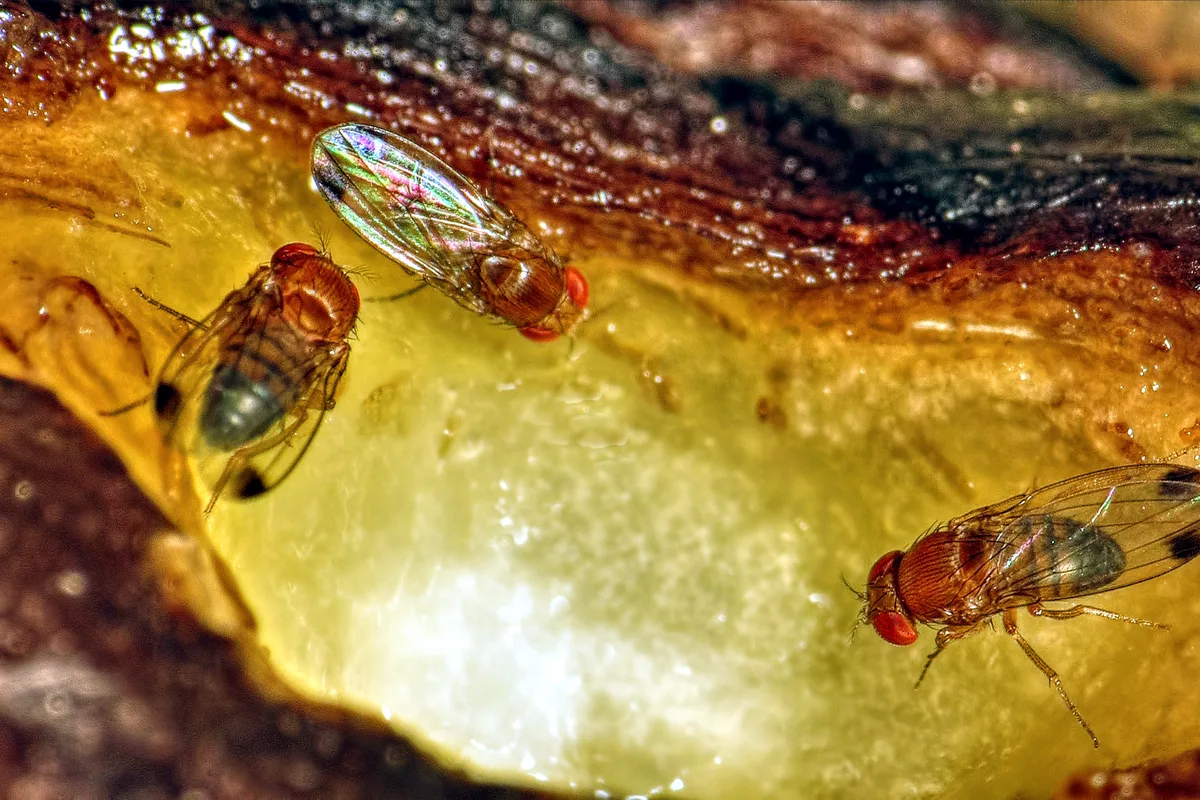
Fruit flies live fast: an adult lays up to hundreds of eggs in fermenting material, and the egg-to-adult cycle in a warm kitchen runs about a week. The adults around your fruit bowl are only the visible part. The real population is larvae in the slimy film inside a sink drain, a dishwasher sump, a mop bucket, the drip tray under the fridge, or a single forgotten onion rotting in a pantry corner. Killing adults changes nothing while the nursery produces replacements on schedule.
That is why kitchen sprays fail so completely (they address the tip) and why vinegar jar traps half-work (they catch some adults and prove the diagnosis without ending it). The two-part method matches the life cycle: sanitation removes the breeding substrate, and a continuous light trap removes adults before they find the next substrate, including the ones still emerging for a week after cleanup.
The fix, in order
Cheapest first, in order. When a step solves it, you are done; the product step is for the cases the free steps cannot finish.
Free step
Hunt the nursery with a flashlight
Check drains (lift the stopper and look for slime), the garbage disposal rim, recycling with residue, the fridge drip tray, and every stored potato and onion. There is usually one source, and it is usually something small you overlooked.
Free step
Scrub and starve the site
Scrub the drain's reachable slime with a bottle brush, pour down a kettle of near-boiling water, take out every ripe item or refrigerate it, and wipe the counters' sugary films. The nursery's food and moisture are the levers.
The product step
Plug in the Zevo where they gather
A Zevo trap in an outlet near the source zone, left on continuously: it harvests the adults, including each new emergence, while the cleaned site stops producing. Expect the cartridge to fill fastest in the first three days.
The product for this step
Zevo Flying Insect Trap
Habit step
Hold sanitation for two full weeks
One life cycle is a week; two weeks of no new substrate is what 'gone' means. Left in place after the outbreak ends, the trap tells you early if fruit flies come back.
The evidence, in tiers
Tier 1 · The method
Source elimination plus adult trapping is the extension-service standard for fruit flies; the life-cycle timing (about a week egg to adult indoors) is documented in entomology guidance.
Tier 2 · This product
The Zevo Flying Insect Trap holds 4.6 stars from 18,549 ratings at Target (November 2026).
We have not trapped flies for this guide. The protocol follows the insect's documented life cycle and extension guidance.
Tier 3 · What owners report
Owners praise the trap's night catch (the cartridge proves the invisible population) and the failures cluster on trap-only deployments where a drain nursery kept producing: the two-part structure of this page is the correction to those reviews.
The alternatives, conceded where they win
| Option | What it is | The honest verdict |
|---|---|---|
| Zevo light trap plus cleanup | Continuous adult capture while sanitation ends breeding | The pick: it runs silently all day, catches what jar traps miss, and the cartridge readout tells you when you are winning. |
| Apple cider vinegar jar traps | Fermentation bait under a paper cone | Wins on price and as a diagnostic (a full jar in a day proves fruit flies and a nearby source); it loses as a solution, catching a fraction of adults while the drain keeps manufacturing them. |
| Bug zappers | Grid electrocution | Wins outdoors for larger flies; indoors it is loud, scatters debris, and fruit flies are weakly drawn to its spectrum. It looks like the right tool, but it does not do this job. |
The honest price comparison
The honest comparison is your time and temper across a month of recurring flies, or a pest visit at $75 and up that will mostly deliver this page's sanitation lecture. The trap at about $20 is the only purchase the problem actually requires.
Where it falls short
What follows is drawn from the product's own reviews: the complaints and failures buyers report after living with it.
- It does nothing about the nursery; deployed alone, it catches adults forever and solves nothing, and this page's ordering is deliberate.
- Cartridges are a consumable; a heavy infestation fills one fast, which is informative but not free.
- It catches what flies to light. A breeding site in a dark cabinet void still needs the scrub, not the trap.
The product, in short
Zevo Flying Insect Trap
Questions people ask next
How can I tell fruit flies from drain flies?
Fruit flies are small, tan, red-eyed, and hover at fruit, bottles, and the sink generally. Drain flies (moth flies) are fuzzy, moth-like, and sit on walls near one drain. Different insect, different page: the drain-fly guide is in this family.
The trap is full but I still see flies. What is left?
A second nursery. The usual stragglers: a mop or sponge left wet, a dishwasher's standing water, plant saucers, or the recycling bin's residue. Work the list again with the flashlight; the trap's catch rate will tell you when you have found the last one.
Can I skip the trap and just clean?
Yes, with patience: adults live a few weeks, so a thoroughly cleaned kitchen clears in two to three weeks on sanitation alone. The trap shortens that to days and confirms the win. It speeds things up, and it is sold that way.
Do they come from the bananas themselves?
Often, yes: eggs ride in on produce and hatch as fruit ripens. A rinse of new fruit and refrigerating ripe items breaks the import route, which is why spotless kitchens still get outbreaks after a big shop.
University extension guidance on fruit fly life cycle and source control · Target product record for the Zevo Flying Insect Trap (November 2026)
The Fix JournalCase 04Home Systems