Cloudy Headlights: Restore Them or Replace Them?
Headlight lenses cloud because their UV coating fails and the polycarbonate underneath oxidizes. A restoration kit removes the damaged layer and seals the lens again. It works, but it is maintenance, not a permanent cure, and the seal lasts one to two years, not forever. This page prices it that way.
The short answer
Restore, do not replace, on the first failure: a Meguiar's restoration kit sands off the oxidized layer, polishes the lens clear, and seals it, for about $30 against $150 and up per replacement lamp. Meguiar's is the best-known pick in this category. This page quotes no review count for it, because the pick does not rest on one. What this page claims is the mechanism and the category standing, and that the seal lasts one to two years, not forever.
Why does this happen?
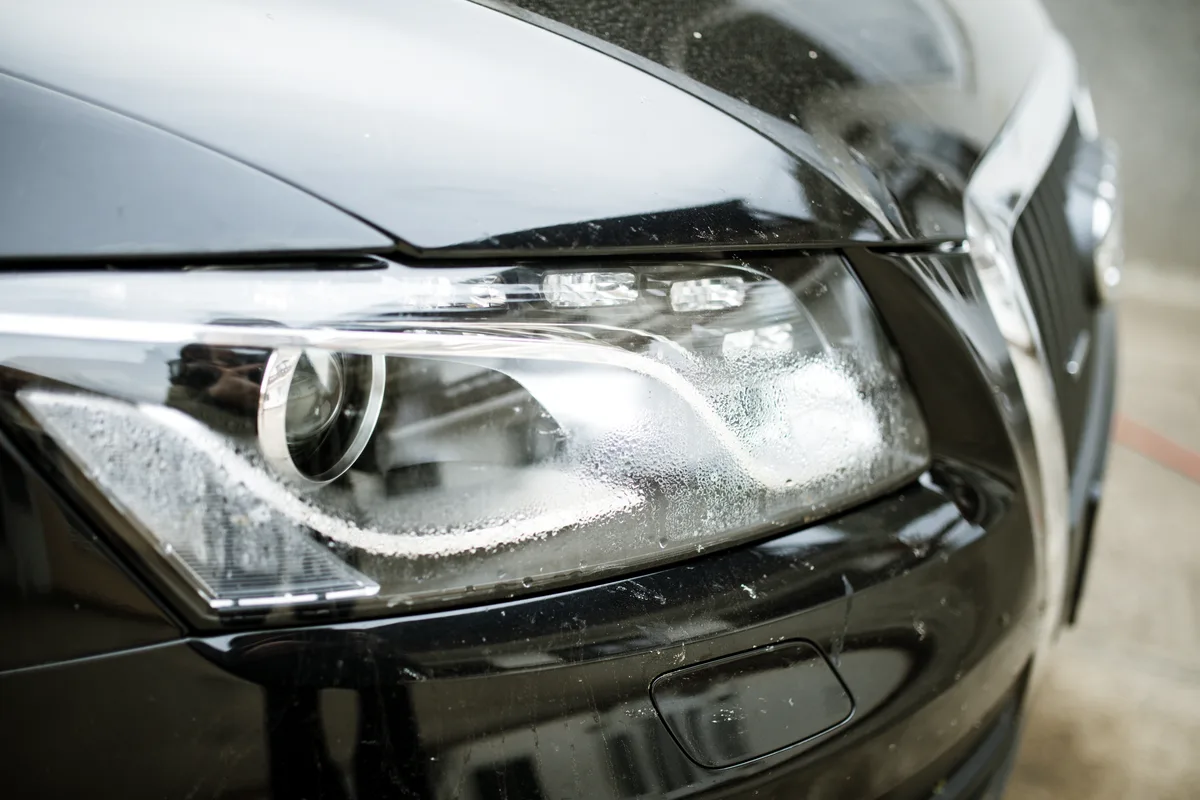
Modern headlight lenses are polycarbonate, light and impact-proof, with a factory UV-resistant hard coat. Sunlight and heat degrade that coat across five to ten years; once it fails, UV oxidizes the polycarbonate itself, producing the yellow haze that is literally a surface layer of damaged plastic. The haze can be removed because the damage is only a very thin surface layer, measured in microns. Underneath it, the lens is still sound, in the same way a shallow scratch in paint can be polished out. The safety stakes are not cosmetic: oxidized lenses can cut light output dramatically, and the cloudy-car population is measurably less safe at night.
Restoration works by controlled removal: progressive wet sanding (typically 1000, then 2000, then 3000 grit) levels the oxidized layer away, polishing compound refines the surface to optical clarity, and a UV sealant replaces, temporarily, the factory coat that failed. One limit applies to every kit: sealants you buy in a kit do not last as many years as the factory hard coat. The clarity fades again over one to two years of sun, and you repeat the job with what is left in the kit or with a new one. Toothpaste, the famous folk remedy, is a mild polishing compound with no sanding range and no sealant; it demonstrates the principle on light haze and loses to the real sequence on real oxidation.
The fix, in order
In order, cheapest first. Stop at the step that solves it. The product step is the last resort, not the starting point.
Free step
The wet test, ten seconds
Wet the lens thoroughly. If it looks markedly clearer wet, the damage is the surface layer and restoration will work (water fills the microtexture, previewing the polished result). If it looks the same wet, read the triage before buying anything.
The product step
Mask, sand in stages, keep it wet
Tape the paint around the lens. Work the Meguiar's kit's stages in order, wet-sanding with light pressure in alternating directions per stage, rinsing between grits. If you rush a grit stage, you will leave swirl marks. Work through the stages in order; that is what makes the kit work.
The product for this step
Meguiar's headlight restoration kit (Heavy Duty class)
The product step
Polish to clarity, then seal immediately
Polish until the lens looks as clear as it did in the wet test, clean it fully, and apply the sealant the same day. Bare polished polycarbonate oxidizes again quickly, and the sealant is half the job, not an optional extra.
Habit step
Maintain the seal on a calendar
A spray sealant refresh every few months, or a yearly light polish and re-seal, stretches the result toward the long end of its range. Park nose-out of the afternoon sun where you can; UV is the enemy and shade is free sealant.
The evidence, in tiers
Tier 1 · The method
The oxidation-removal mechanism and the wet test are the auto-detailing trade's standard diagnostics; the sealant's one-to-two-year life is the honest figure the trade itself quotes for aftermarket coatings.
Tier 2 · This product
Meguiar's is the verified reference pick of our research for this problem class; its research file did not record a review count, and this page does not invent one. The kit categories (hand and drill) are standardized enough that the pick rests on the brand's detailing standing.
We have not restored a test headlight for this guide. The wet test lets you check your own lens before you spend anything, and that check should come first.
Tier 3 · What owners report
Owners report the transformation as the most satisfying $30 in car care, with the recurring disappointment being re-haze at year two from seal neglect, exactly the footnote this page prints in the verdict.
The alternatives, conceded where they win
| Option | What it is | The honest verdict |
|---|---|---|
| Meguiar's restoration kit | Sand, polish, and seal in one system | The pick for surface oxidation: complete mechanism, both lenses, at a tenth of one lamp's price. |
| Replacement headlight assemblies | New lamps, factory fresh | Wins when the lens is cracked, internally fogged, or degraded through, and restores the factory coat's multi-year life; it loses at $150 to $400 per side for damage that is microns deep, which is most cases. |
| Toothpaste or baking soda polish | Folk abrasion without stages or seal | Wins a light haze for free and demonstrates the principle honestly; it loses on real oxidation (no sanding range) and on duration (no sealant), leaving a clearer lens that re-clouds in a season. |
The honest price comparison
The honest comparison is a mechanic's restoration service at $75 to $150 per pair (same method, professional pace) or the replacement assemblies. The kit at $25 to $35 is the method without the labor charge, twice over if you maintain the seal from the same box.
Where it falls short
Below are the weaknesses from the product's own record: where buyers say it falls short, in their numbers.
- It is maintenance that lasts one to two years, not a cure. If you expect a factory-permanent result, you will call year two a failure. This page would rather tell you that now than sell you the kit on a false promise.
- It cannot help internal fogging, cracks, or deep degradation, and the wet test is a condition of the recommendation.
- Bad technique writes permanent swirls: skipping grits or dry sanding converts haze into scratches, so the stages must be followed with the patience they describe.
The product, in short
Meguiar's headlight restoration kit (Heavy Duty class)
Questions people ask next
How long does the whole job take?
About thirty to forty-five minutes per lens for a first-timer working carefully. The drill-driven tiers are faster; the hand tiers are more forgiving. Either way it is a Saturday morning, not a weekend.
Can I just use the polish without sanding?
On very light haze, yes, and the wet test's margin tells you how light yours is. On heavier oxidation, polish alone shines up the damaged layer so it looks clear for about a month, but the damage is still there. The sanding is what removes it; the polish is only the finishing step.
Will it pass inspection?
In states that inspect light output, restored lenses typically pass when the restoration is genuine, since output is what is measured. A lens degraded through its depth will not, and the inspection then agrees with the triage: replace.
How do I keep the new-car look longest?
Keep the sealant renewed (step four), wash the lenses when you wash the car (road film is abrasive and carries UV damage), and park in shade where you can. Sunlight and neglect are what undo the work, and steady upkeep is what prevents it.
Auto-detailing trade practice on polycarbonate oxidation and restoration · Meguiar's product documentation (November 2026)
The Fix JournalCase 01Car & Fabric