Slouching at Your Desk: Posture Cues That Actually Help
A posture strap cannot correct your posture, and this page will not claim it can. It reminds you, by pulling when you slump, and a reminder only works alongside the larger fix: fitting your chair, setting your screen height, and moving regularly. Bought as a reminder, it is a fair tool. Bought as a cure, it will not work.
The short answer
Buy it as a reminder, never as a cure. A BackEmbrace strap, worn for short sessions, makes your slump noticeable the moment it starts. That awareness, paired with the desk fitting on this page, is how it works. It does not correct posture, strengthen anything, or treat pain. This is the product with the weakest evidence in its family, labelled as such on purpose. The desk setup is the fix. The strap is only the reminder.
Why does this happen?
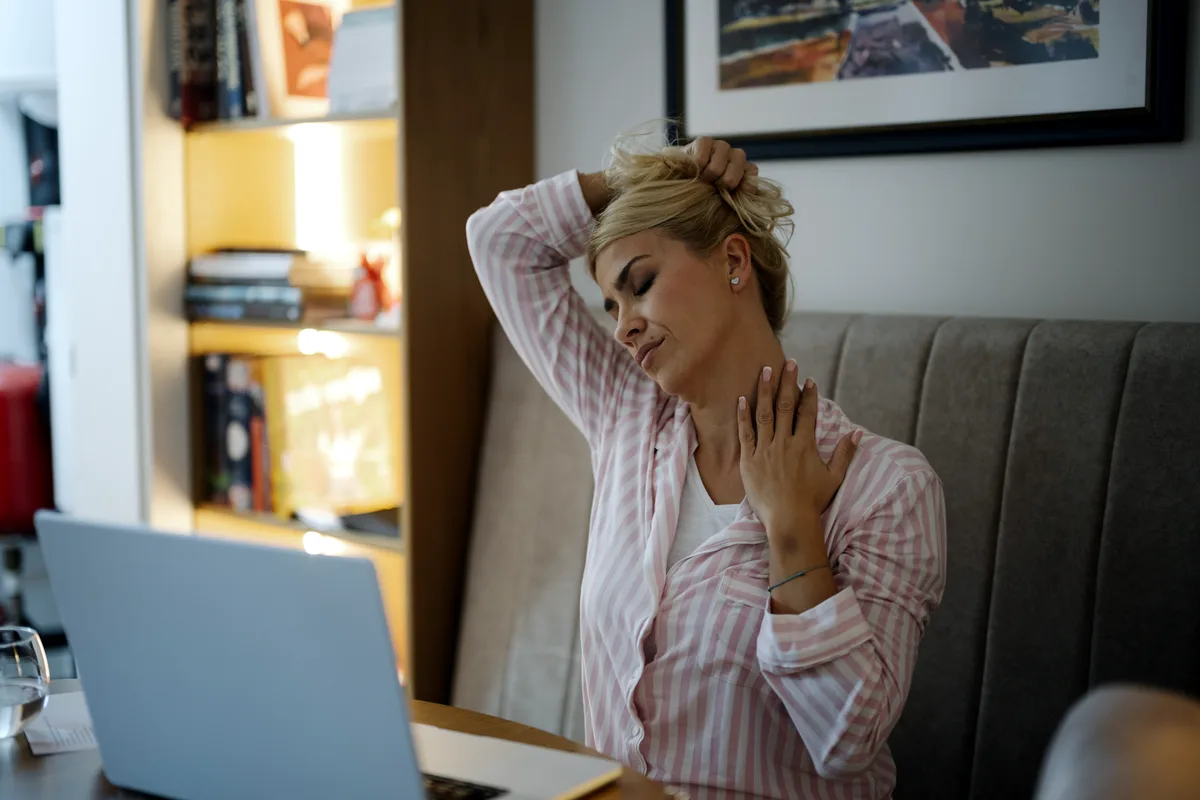
Desk slouching is not a character flaw or a spine disease. It is the predictable result of a workstation that puts the work where your body must fold to reach it, held for hours by muscles that tire into the fold. Holding a bent posture loads the tissues of the spine in ways that produce the familiar end-of-day ache. What damages you is how long you stay in one position, more than the position's exact angles. That is why posture science has moved from 'sit up straight' to 'change position often'. In the current ergonomic consensus, the best posture is the next one you move to.
That is the background for what the strap can honestly do. A retraction strap gives you feedback through feel: when you slump, it pulls, and you notice. Noticing is the hard part of changing a habit, and for some desk workers a wearable reminder breaks eight hours of sitting on autopilot in a way a sticky note cannot. What it cannot do is strengthen the muscles that hold you up. Wearing support all day arguably rests them. It cannot correct a structural curve, and it cannot substitute for the chair and screen setup that creates the fold. Described in those terms, it is a modest, legitimate tool. The category's marketing, which this page does not repeat, sells it as a medical correction.
The fix, in order
The steps are laid out cheapest first. Stop at the one that solves it; the product step matters only where the free steps fall short.
Free step
Fit the desk first (the actual fix)
Set up your chair and screen as the chair page in this family describes: feet flat, lower back supported, screen top at eye level an arm's length away, elbows near ninety degrees. Do this for a full week before judging whether you need a reminder at all. Many 'posture problems' are really furniture problems.
Free step
Install the movement rhythm
A timer that stands you up every 30 to 45 minutes works better than every wearable ever sold, because how long you sit is what damages you. The strap below comes second to this step.
The product step
Use the strap as a cue, in short sessions
BackEmbrace over light clothing, one to two hours at a stretch, never all day: its pull when you slump is the product. Increase session length gradually if it suits you, and abandon it without regret if your awareness holds without it; dependence was never the design.
The product for this step
BackEmbrace posture strap
Habit step
Build the muscles that make it unnecessary
Rows, shoulder-blade squeezes, and upper-back extensions, a few minutes several times a week, strengthen the exact muscles the slump tires. This is the only step on the page that changes what your posture defaults to when nothing is reminding you.
The evidence, in tiers
Tier 1 · The method
The movement-and-variation consensus in ergonomics is documented across occupational health bodies; the strap's proprioceptive cueing is its manufacturer's own mechanism claim, repeated here at exactly that strength and no further.
Tier 2 · This product
The product is named because it is the category's honest example, with its evidence class labeled the family's weakest in the verdict. It is a small maker's product, sold direct, and its record is its user base's reporting rather than any large retail average.
We have not worn a test strap for this guide. This page's core advice is the free steps, which carry the ergonomics consensus; the product is an optional cue with its limits printed in its own verdict box.
Tier 3 · What owners report
User reports divide exactly as you would expect from how it works. People who paired it with a desk refit call it the tap on the shoulder they needed. People who wore it all day at a bad desk report soreness, and a strap left in a drawer. The difference was never the strap.
The alternatives, conceded where they win
| Option | What it is | The honest verdict |
|---|---|---|
| BackEmbrace strap as a short-session cue | Proprioceptive reminder inside a desk refit | The pick, narrowly and honestly: it does one real thing (noticing) for the workers whose bottleneck is noticing, at a fair price, with its ceiling printed on the label this page gives it. |
| Rigid posture braces and correctors | Mechanical shoulder retraction worn for hours | It loses on how it works. A device that holds you does the muscles' job for them, and can leave you weaker and sorer. Wearing it all day goes against the advice to move and change position. The reminder lets you correct yourself. The brace does it for you. |
| A posture app or camera reminder | Software that watches your screen posture and nudges | Wins on price and on leaving your body alone, and for camera-comfortable workers it cues as well as fabric does; it loses when you leave the desk's sightline, where the strap still travels. Either cue is defensible; the desk refit is not optional in either world. |
The honest price comparison
The honest comparison does not flatter the whole category, and this page prints it anyway. The strap at $30 to $40 is optional equipment for a problem whose fixes, a fitting checklist, a timer, and a few exercises, are free. Buy it only if your problem really is awareness, after the free week proves it.
Where it falls short
The product's own review record supplied the weaknesses below. A recommendation that hid them would not be worth much.
- Weakest evidence in the family, stated in the verdict: cueing is plausible and user-reported, not trialed at the level of this page's stronger picks.
- All-day wear is misuse with a soreness pattern of its own; the short-session discipline is a condition of the recommendation.
- It is sold by a small maker, direct, whose storefront has moved platforms in the past year. Buy through its current store and keep the returns terms to hand. With small makers, that is your real protection.
The product, in short
BackEmbrace posture strap
Questions people ask next
Will it fix my posture permanently?
No product will. Posture is a habit that depends on your surroundings and your muscles. The strap can help the habit notice itself while you fix the surroundings and build the muscles. Anyone promising a permanent fix from fabric is selling you what this page warned about at the start.
How long should I wear it each day?
Start at twenty to thirty minutes, building toward one to two hours in a session if comfortable, never the whole day, and never while sleeping or exercising. Soreness is a stop signal, not a progress report.
Is slouching actually bad for me?
Sustained, unvaried posture is the problem more than slouching per se: your tissues dislike any position held for hours, including a rigidly perfect one. This is liberating news: you do not need to sit like a portrait; you need to move like a person.
What exercises actually help?
The anti-slump set is short: band or dumbbell rows, scapular squeezes, prone or standing thoracic extensions, and chin tucks, done briefly and often. A physiotherapist can tune the set to your body in one visit if pain enters the picture; for the ache class this page serves, consistency beats complexity.
Occupational ergonomics consensus on postural variation and movement · BackEmbrace product documentation; ShareASale closure (October 2025) as reported (November 2026)
The Fix JournalCase 15Body, Sleep & Care